The story of the Sand Creek Massacre dominates accounts of the interface between whites and Cheyenne and Arapaho people in the mid-1800s. The entire exhibit on them in History Colorado hinges on this event, which is identified as a day that changed everything.
Traditionally, these two groups hunted, fished, and gathered over broad plains areas stretching from present-day Canada to Mexico. They made treaties as early as 1851 in which the U.S. government promised to keep permanent settlements out of their traditional homelands. This is not the place to review all of those agreements. Suffice it to say that treaty after treaty was broken, including by such standard heroes as Abraham Lincoln.
In September of 1864, the governor of the territory promised that remnants of the tribes would be safe if they gathered at a site on Sand Creek flying the U.S. flag and a white flag of surrender. In November, with those flags flying, a U.S. military raid killed 230 of them there — women, children, old people, chiefs — in dehumanizing ways, too gruesome to report in the exhibit. After reading some of the details in Tommy Orange’s book There There, I was nervous about taking the girls into the exhibit. Fortunately, the exhibit is honest about the horror without mentioning the worst details.
I was impressed that two of the junior military commanders involved in the event protested at the time and afterwards, paying their own penalties in the end for speaking up.
It was the day that changed things forever because the Cheyenne and Arapaho could never again trust the U.S. government’s promises. Witness today.
The Cozzens covered wagon arrived after these two turning point acts of violence occurred – the Meeker and Sand Point Massacres. There is nothing in the family history to indicate whether James and Helen were attracted specifically to the Meeker utopian model. Irrigation has certainly played a key role in their land management and farming. They may never even have met any Cheyenne, Arapaho, or Ute — neither they nor their descendants.
Somehow, however, that timeline does not free me from a sense of connection to the violent removals. This is especially true when my government continues to support large- and small-scale dehumanization today with accompanying devastating violence.
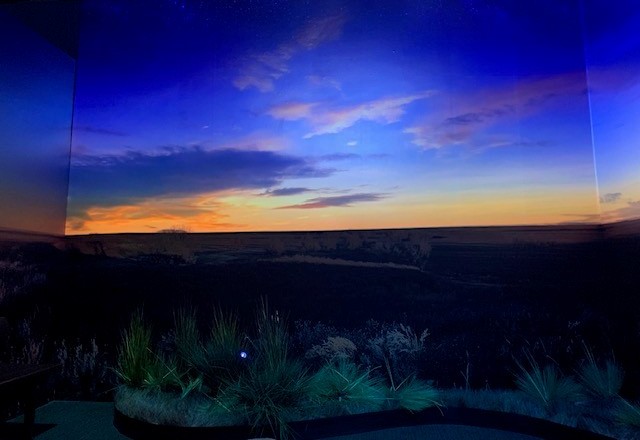
The stop by the sugar beet field near Cozzens land (see Part One) was less than quiet and contemplative, despite my intention. But I found the quiet place I needed in the Sand Creek Massacre exhibit at the history center. The designers had provided an area with pictures of the prairie projected on the walls, going through the cycle of light and stars over a day. The prairie birds sang accompaniment. There I could hold the pain of these stories in my heart. Like the Cheyenne, Arapaho, and Ute, like our community, I am changed forever.
 Finding My Place