There are eleven people named Cozzens buried in Linn Grove Cemetery in Greeley, Colorado. I am related to all of them. Whose land are they in?
Quakers are taking Right Relationships with Native People seriously. Workshops often begin with sharing family history. For me, a part of my family history was documented in 1980 by an energetic non-Cozzens grandfather for his Cozzens grandchildren.
According to the histories he gathered, the Cozzens name arrived in the U.S. from Ireland in the early 1800s in New York. William and Nancy Cozzens quickly moved west to Missouri. The Ponder branch arrived from Germany in the 1830s, traveling up the Mississippi to St. Genevieve County, Missouri. In the next generation, James B. Cozzens met Elizabeth Helen Ponder there. They married and moved further west, in a classic pioneer story. In a covered wagon with their seven-month-old son (my grandfather), they moved to Weld County, Colorado, where Greeley is located. The family history documents several plots they occupied, eventually “proving up” on a homestead near Eaton and expanding from there.
Helen Ponder Cozzens had eleven children. When eight surviving children inherited shares of the farm in 1943, my grandfather sold his to a brother and came east again. Others stayed in the West, enough to fill one plot in Linn Grove Cemetery and spread out to another. Two Cozzens descendants from my generation still farm the Cozzens Home Place and have added to it.
Our family finances grow directly from that plot of land. My grandfather put the money from his share of the farm into a modest set of investments, part of which eventually came to me and went into the down payment on my family’s first house. The land in Colorado has given my family shelter for nearly fifty years.
But whose land were James and Helen on? The Right Relationships workshops always raise that question. In answering it, I realized I needed to go back and stand on that land in Colorado in order to acknowledge a place where I stand in America’s racial history.
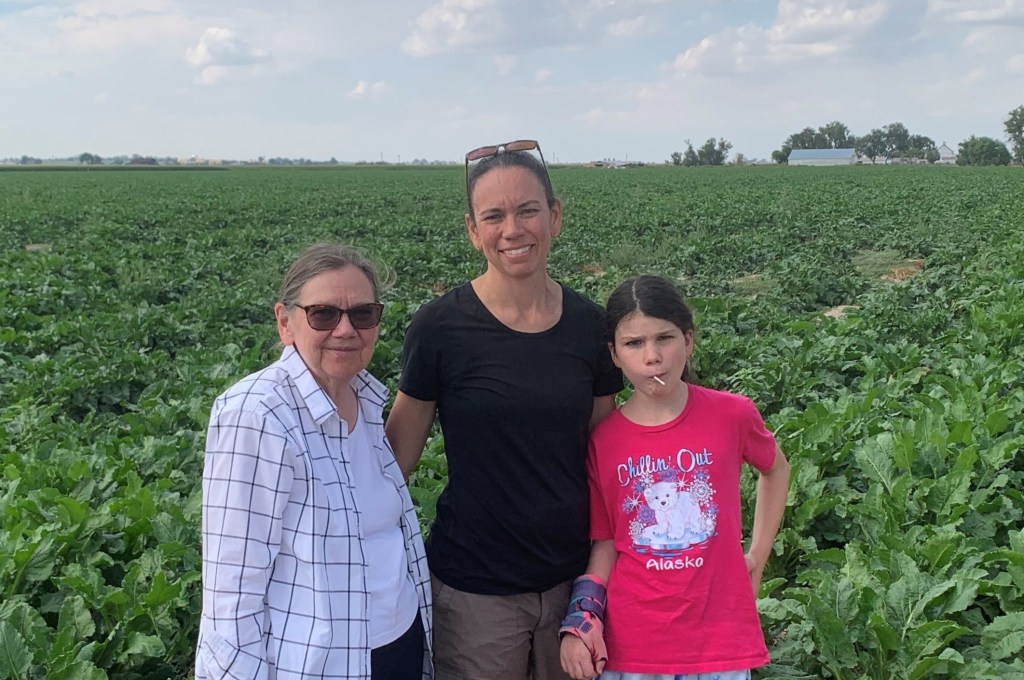
Last Saturday, three generations of us did that together. My daughter, two granddaughters, and I visited the Greeley Historical Museum, drove through Cozzens land, and took a moment to stand near it, next to a field of sugar beets, doing the spiritual work of feeling the presence of the people who belonged to that land before the homesteaders arrived.
We learned a lot on the trip about farming on the prairie – water as Western Gold, the Dust Bowl, and more. But the trip was primarily planned as a journey of learning about the Cheyenne, Arapaho, and Ute who earlier moved across those lands in their annual hunting and gathering cycles. Parts Two and Three share those lessons.
 Finding My Place