December 1, 2023
I am just back from a trip down the memory lane of my historian husband, returning to places he holds dear from his year in Munich as an exchange student in high school. He found a new history museum to include in our visit, drawn by its exhibit on the history of National Socialism (commonly known as the Nazis) and the role of Munich as “the center of the movement.” Juan describes his historical interests as “Nazis and Commies,” so this was a natural for him. For me, it was fascinating and deeply challenging. We ended up spending all day there, because we were both drawn to look at the whole thing, 1918 to the present.
Telling history as richly and deeply as this exhibit does generates a poem of sorts, a deep spiritual experience. I want to share some of the depth of that experience with you. But the threads are interwoven in so many ways…
The timeline of the exhibit is the standard events that history books report: the huge reparations bill Germany was given from World War I, the shaky new republic, the rapid growth of the Nazi party in the early years of the Depression; political repression and terrorism after they took power; the war itself. The institutional story of their move into absolute power is very scary because of its parallels to the threats now to democratic institutions in the United States. Within the first few panels of the exhibit, I knew there were lessons to be learned there about my own time and place.
The heart of the exhibit is not, however, the standard military-political history but rather pictures and biographies of individual people and how their lives intersected with what unfolded. The curators have worked hard to bring to life many people whose stories have not often been told.
One group are those who opposed the Nazis: feminists who raised issues of women’s rights; students and professors who tried to organize opposition; the few religious groups and religious figures who raised the alarms, often while their religious bodies did not. Could these voices have stopped the Nazi wave? At the point in the timeline that marked the Nazi rise to power, the exhibit summarized its answer:
“The Nazi Party’s path to power was not an inevitable, triumphant march. The defensive measures of the state and civilian resistance never came together to form an effective counterforce. The Weimar Republic failed because people didn’t oppose extremism vigorously enough.” [quoted from text in the exhibit]
But the resistance portraits do not stop at that spot in the timeline. From as early as 1933, Dachau (just outside Munich’s borders) filled with prisoners who put up political opposition. The resisters continued to stand up, right through the run-up to the war and the war itself – often standing up only to be mowed down. After the war, Munich recognized some of them as heroes, including Kurt Huber, a participant in the “White Rose” university movement that called for an end to National Socialism in 1943. The school my husband attended when he was in Munich in the mid-1960s had just been renamed for Huber.
A second group that appears through the exhibit include but go beyond the political prisoners, and beyond the millions of Jews that eventually dominated the detention camps numerically. Sinta and Roma (also known as Gypsies), homosexuals, those displaying alleged genetic flaws or purportedly “asocial” behavior, including mental illness, also ended up in the concentration camps or executed. In the decades following the war, these groups needed to fight for recognition of their experience.
The central characters in the story, and the ones whose experience spoke to me most in relation to the United States today, are the “Aryan” residents of Munich. They appear in shots of crowds cheering their Nazi leaders, celebrating a visit by Mussolini, applauding the “peace pact” that handed over part of Czechoslovakia to Germany eleven months before the war started. It is obvious that the “Aryans” would have seen and perhaps personally broken windows of the local department store on Kristallnacht, watched the Jews forced to march through the streets of the city on their way to death, seen the forced laborers from Dachau who worked in their streets. They knew.
At the core of the Nazi appeal to these people of Munich was a vision:
“The central concept of Nazi social policy was the ‘people’s community’ – popular ethnic community. This propaganda buzzword suggested that all social conflicts and divisions could be overcome. It spread the illusion that Germans could rest secure in the solidarity of a ‘racially pure’ community of mutual background and addressed the desires and needs of large segments of the population, giving the Nazi dictatorship a major portion of its appeal. The regime staged common mass events, promised followers social assistance, and offered career opportunities.
… Local party leaders and ‘block wardens’ monitored the behavior of their ‘ethnic comrades.’ Informants were everywhere and fear of repression encouraged people to conform. …
The ‘people’s community’ ideology ran in several directions. Many ‘ethnic comrades’ regarded the exclusion of ‘others’ as confirmation of their prejudices and belief in their own ‘superiority’ and voluntarily went along with the idea. But the pressure to conform rose constantly since it was the party that decided who belonged to and who was excluded from the community. The result was a racist society.” [quoted from text in the exhibit]
Where did the vision lead this group of Munich residents? As the tide of the war turned, the Allies turned Munich into rubble, just as their German Luftwaffe had bombed London and Warsaw. Even in the air raids, not everyone was allowed into the shelters.
A fourth group of people whose stories interlace the historical timeline are those who participated knowingly and actively in the horror. Two units of Munich police moved into military operations. Munich doctors conducted the experiments in the concentration camps. Other leaders from the city gave the orders and carried out mass murders. After 1945, when the war-torn world set up extraordinary measures in the search for justice, punishment for these figures was tiny in proportion to the death and destruction their vision had unleashed.
In the exhibit, one stands in the midst of a country trying to make sense of its history, of all the people and all the roles they played in it. The building occupies the spot where Hitler’s “Brown House” or party headquarters stood. The “Fuhrer’s Building,” where so many orders to torture, kill, and destroy were given, is next door. The square that held the exhibit’s crowd scenes is visible out the windows.
Standing there, I stood also in the midst of contemporary America, seeking not only to make sense but also to find a way forward to act, so that the past does not become the future.
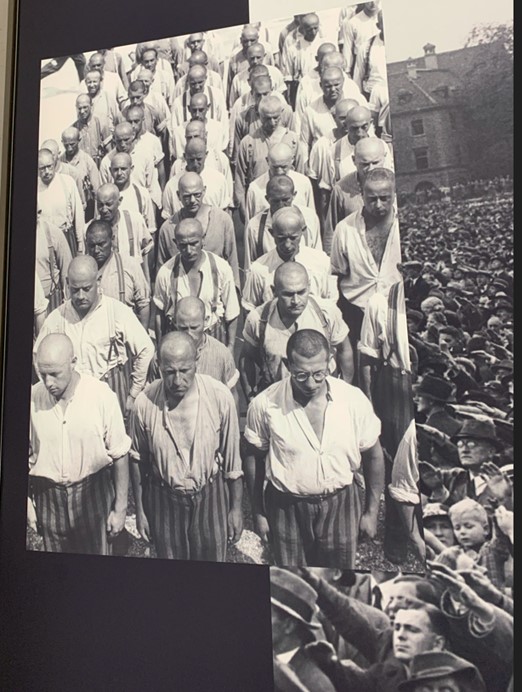
Left: Early prisoners at Dachau. Right: Crowds in Munich. Picture from the exhibit.
 Finding My Place