I am on my way back from two weeks in a country that is literally on the other side of the world from where I live, a place that is home to 1.4 billion of my brothers and sisters. I gave a talk at a university, attended a board meeting, and contributed to a professional meeting, as well as spending four days as a tourist. With my husband, I spent about half my time in the South and half in the North.
I can’t think of one word to describe India. Perhaps fascinating.
I know that India is a lower middle-income country. I have traveled in several middle income countries in Latin America and Africa — Brazil, Colombia, Costa Rica, Mexico, Kenya, Ghana, South Africa. Delhi has a visual configuration that reminds me of a combination of Ho Chi Minh City and Bogota. The streets are jammed with traffic — about half the space taken up with cars, many taxis or private cars, some small trucks (brightly decorated, with polite messages saying “blow horn” on the back door — more later on what that means), and lots and lots of motorbikes, mostly occupied by one man each, sometimes with a woman on the back. So there is enough affluence there to support that level of vehicle ownership, while private car ownership (or at least driver-ship) seems relatively rare.
The traffic pattern itself will always be a strong part of my memory of this trip. Lanes are a very informal suggestion in the flow of traffic we experienced in all the cities and the roads in between. In the jam-packed traffic in the cities, there are few traffic signals and even fewer traffic police. Mostly, as in Vietnam when we were there many years ago, the traffic flows in one big river. Motorbikes dash in and out wherever they can, tuk-tuks chug along, cars jump forward more quickly when possible, turns across traffic require serious assertiveness. It’s a mess.
In the main roads outside the cities, it’s the same pattern just a little more open. “Blow horn” is the request the small, slower-moving trucks make to remind other drivers to let them know when they are passing them. The sound of the flowing river of traffic is therefore of dozens of horns, not angry, but just lots of drivers letting others know they are there or suggesting that others move out of the way. Remarkably, we saw only one accident. The first rule of the road is don’t hit anything. The way to do that is to be prepared at all times to slow down, to a crawl if needed. From that pause, you dash forward when opportunity opens if you are in a car that is powerful enough to do that.
The river of traffic flows through many lovely parks and open public spaces in New Delhi (not in crowded Old Delhi). Another strong impression of riding there is the green of trees and shrubbery. They seem to be strongly valued in Delhi, a bit less so in the other cities we visited in the North (Agra and Jaipur), but still evident. The reason is clear: shade. Shade not only for people but also for cows. (Street dogs, ubiquitous, seemed to prefer lying death-still in the sun.)
Except for the parks, surrounding the river of traffic are lots and lots of people trying to sell things, or napping with things they will try to sell when they wake up. Mostly fruits and sometimes vegetables seem to be for sale. A few venders approached our car with street goods, I think in Agra, and beggars in Jaipur. Also lining the roads are shops and open storage areas with things like building materials for sale. The road between Agra and Jaipur, which runs through a farming area, had a nearly continuous border of stores, small restaurants, and other businesses. (In one section near Jaipur, there were dozens of businesses selling pink sandstone items, including small shrines — all the businesses appearing to have identical wares available.)
For a long way out of Agra, the countryside did not appear to be farmed. But eventually, farms appeared. We were there at the beginning of winter, so the only crops still in the field were what I think were corn stalks. But the fields themselves were neatly prepared for whatever was coming next, with plowed rows in small fields ringed with short walls, presumably to allow for flooding either from rain or irrigation (but I did not see irrigation ditches). The guide from one palace we explored told the story of an ancient lake nearby that captured rainwater, which fed into various systems in the palace. When the lake dried up, the emperor moved the whole household somewhere else. Our Jaipur guide told us that the monsoon season was just ending, and therefore the hills were green. But winter is a dry time — good for tourists but not for farmers.
We took a very big new highway back into Delhi from Jaipur, with no commercial development around it. This made it easier to actually see the land. Unexpectedly for a desert, it is dotted with trees. I am very curious about water in the whole area and would like to learn more.
We did not see any slums in Delhi, although I am sure they exist. They just don’t get included in tourist packages, which is how we were moving around.
The previous description is all based on what we saw in northern India. In the South, I was mostly in neighborhoods on the edge of Trivandrum (Juan moved around the city much more, while I was in the professional meeting). The full traffic experience came on our two-hour car ride from our hotel to the houseboat dock in Kollam. We were on the major road, which was being widened and therefore had lots of construction zones. There had been a huge downpour the night before and parts of the road were flooded. The traffic was essentially as described above — chaotic because of the different kinds of vehicles traveling at very different speeds, with very liberal practices of faster ones passing slower ones. The entire roadway was lined with houses, shops, businesses — no break in the urbanization at least as visible from the roadway.
Trivandrum also seemed to value trees and shade. I remember my impression in 2006 of the south part of the city, where the meeting was held — houses set in the jungle, surrounded by trees. I did not see any parts of Trivandrum where trees were not prominent, not a part of the ecology of living things.
What I have not mentioned yet is the trash. Most visually tragic were the islands of plastic bottles in the waterways where we took the houseboat tour. The families that live around the lake and canal survive by fishing and practicing aquaculture. The houseboats make their living going up and down the water. But no one seems to take responsibility for getting rid of the floating trash. We eventually saw one household that had gathered a lot of plastic bottles. Did they have a recycling business to sell them to? We could not tell. In the North, the plastic bottles were not so prominent, but there was plenty of other kinds of trash, just accumulating near houses and shops, no sign of public trash collection. In the North, we did see a few trucks carrying bales of what looked as though it might be material for recycling. So trash is another research project for me, to go with the research on water.
The river that runs past the Taj Mahal (the Yamuna) is one of the most polluted in the world. The Internet is full of pictures of toxic foam that appeared there a few years ago. Oxygen levels are too low to support any form of fish life. This was just the most dramatic reality that influenced my overall sense that the environment here was a disaster. Trash, toxics — not good. In Delhi, including in the airport, I saw some signs calling for a Clean India, but I saw them only in the airport. I guess they’re for tourists.
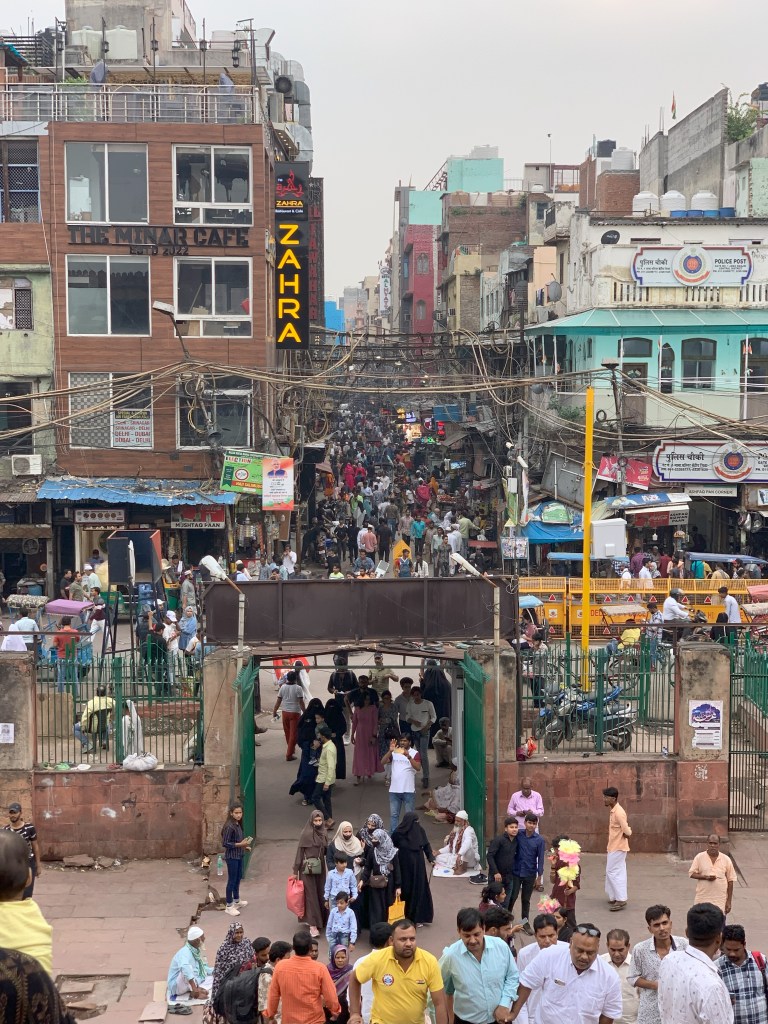
Old Delhi — not too tree-friendly
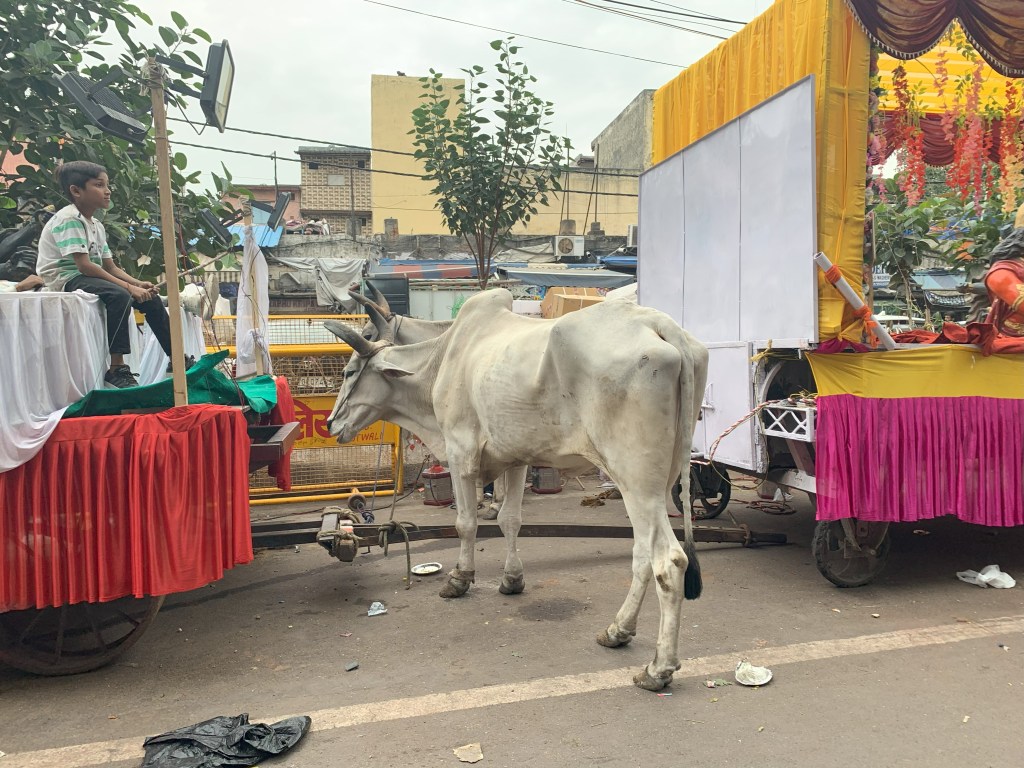
 Finding My Place