Although I did not attempt to join my early-morning worship group (which happened in the evening on Indian Standard Time), I did try my regular morning prayer, which moves from gratitude to stillness to centering.
Gratitude, a la Kimmerer, is a sense of feeling part of all of life and taking responsibility for your part. I had a very hard time feeling this in the environments I was in for the last two weeks. I recognized that I did not know the place. I did not know what made people or communities or organizations there tick. I did not know the names of the trees or the birds (saw several fascinating varieties, but could identify few). As happens when I pray in Redmond, the concrete got in the way — all the things people had put in place that shield them from the earth and what grows from it. Given the challenges of traffic and trash, it was very hard to get a sense of how I could work together with people from this unknown place to move towards “sustainability.” With every action I take at home in that direction (composting, recycling, walking instead of driving, etc.), it seems that someone in India is doing something that erases whatever benefit I might be providing to the planet from what I do. It seems we need to talk to each other about this. But how?
And where would my twenty hours of air travel each direction figure into the conversation?
Stillness — the second part of my daily prayer. This does not come easily when one is traveling. From our hotel window in Trivandrum, we got a little view of sunset and sometimes I had a few quiet minutes enjoying it. Some days I was up early enough to have some quiet time around dawn. Mostly, it was hustle and bustle, during the meeting and also once our three-day sightseeing tour began.
On the middle day of the tour, we were at the Taj Mahal at sunrise. This was fantastic. The place is beautiful at any time, but early in the morning it is spectacular. It is also a place that cherishes trees, that is home to birds, that honors beautiful stones. It has stillness at its heart. Twenty-two years of human labor went into it. I hope the workmen felt deeply moved by what they created.
I also reached out for stillness in the Sikh temple we visited in Delhi — ironically, since this was quite a busy space. Three priests were delivering a reading of a Sikh holy text, one singing and two playing instruments. Some of the faithful were sitting in prayer (I was not allowed to sit with my legs stretched out so we moved to some benches at the back of the sanctuary). But most people there were just moving through, a river of tourists, paying scant attention to the text.
But the chant was clearly centering, the third part of my daily prayer. LED screens were carrying the translation of the songs, all of which seemed to express love for one’s fellow beings and a desire for peace. The songs were well known to those attending; I sat next to a women who was quietly singing along with the repeated lines. Gradually, the songs aligned the souls of the worshippers towards the Center. That centering brought some stillness even in the busy space.
Perhaps my favorite thing in the whole trip was the meal program of that Sikh temple. They feed anyone who asks for food, 20,000 daily. This counts as “taking care of everyone.” The production line is large-scale — huge tubs of dal and other main dishes, an automated naan grill. The investment clearly flows from that Center that is activated in hearts by the chants.
This experience was different from my previous trips abroad because of my daily prayer. In the past, I have traveled with my head, absorbing what other parts of the world are like to grow my understanding of global systems. This time, I traveled more with my heart, trying to open to the experience I share with the people I saw, whether I am in India or at home. We are all on the planet together. What are we making of it? How are our lives intertwined?
When I traveled while I was teaching, I was taking experiences back into the classroom. But now, without students, I need to turn the experience into some other gift. The ecological cost of the trip weighed on me. I felt the wealth and privilege that put us into our tourist bubble and wrapped us in comfort. Touring palaces that reflected enormous centralization of wealth through warfare deepened my questions about how we live together on the earth. These questions will stay with me as I try to bring my experience in India home.
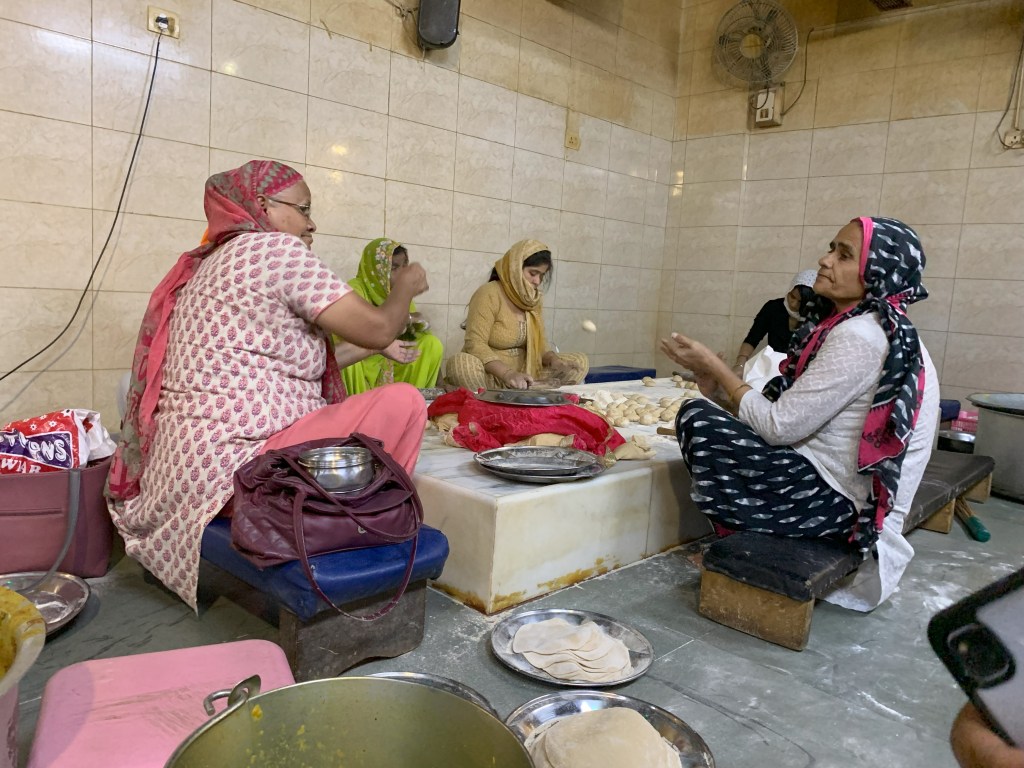
Sikh volunteers making naan for 20,000 people fed each day.
 Finding My Place