This post followed closely on the one that started my personal project “Reimagining Redmond.” I am reposting it here to have a full archive on this site.
13 July 2020
Who lives in Redmond?
In my recent posts, living in the force field of the Black Lives Matter movement, I have been coming to ethical and spiritual grips with the implications of where I live: Redmond, Washington, the home of Microsoft. The affluence of Redmond hangs on the affluence of Microsoft. So I am grappling with the question of where Microsoft fits into the dynamics of inequality here in Washington, in the United States, and in the world.
I realized after my last post that I already had part of the answer to that question from a former doctoral student of mine, Kamau Bobb. In a moving plenary address for the Atlanta Conference on Science and Innovation Policy last fall, Kamau made vividly clear how unlikely it is that any of my Redmond neighbors grew up black and poor in a U.S. city. Education. Public education. Segregated education. Institutional and systemic racism.
Kamau grew up in the system he speaks about. With immigrant parents, he schooled in Brooklyn, Berkeley, and Georgia Tech. He has advised the state of Georgia, led programs at the National Science Foundation, directs a center at Georgia Tech to make computing education real in public schools, and is now leading diversity strategy at Google. His central message is that unequal access to STEM education is denying effective citizenship to black and brown students. To hear his voice on this topic, I recommend his 2019 SXSW EDU address on “Citizenship in the Modern Technopolis” or his conversation with students in California on “Transforming Schools and Neighborhoods.”
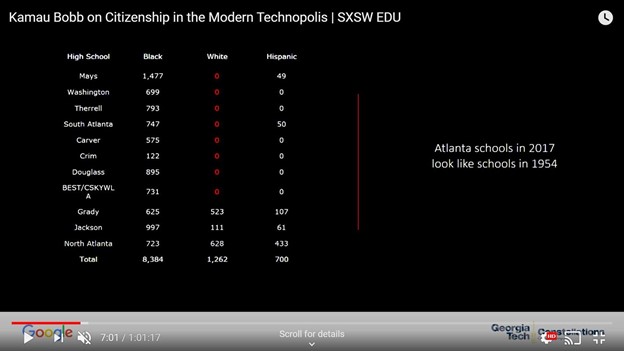
In the Atlanta Conference keynote, he used Atlanta Public Schools to illustrate the dynamics of urban school systems all over the country. Among 11 public high schools in Atlanta, only three have any white students at all — the ones with all the accelerated, international baccalaureate, upscale programs. Even within those schools, the white students are concentrated in those programs. Otherwise, white high school students who live in Atlanta go to private schools. White liberal families whose best friends are black contribute to an education structure segregated by money rather than law. Institutional racism.
Are the majority high school students in Atlanta, the black and brown ones, likely to graduate with computer skills? Highly unlikely, Kamau reports from what he has seen in the classrooms where they are taught. The teachers themselves do not have them. Furthermore, reflecting the low value Americans place on public education, even the teachers are struggling to survive. Kamau points out that in one recent year, public school teachers in ten states were on strike for the conditions they need to educate effectively.
Speaking to the international audience of innovation scholars at the Atlanta Conference, Kamau noted that there have been years when Georgia Tech, his alma mater, admitted no students at all from the Atlanta Public Schools – they did not have the preparation. And if they are not prepared to come to Georgia Tech, they are even less likely to end up working for Microsoft. Or to live in Redmond, Washington. Or to enjoy its good schools, well-kept parks, and friendly police force. I won’t see them as I take my sunset walk by the river. They won’t leave their kids’ bikes by the path.
Redmond’s black population is less than 2%. This is not an accident. This is systemic.
 Finding My Place